
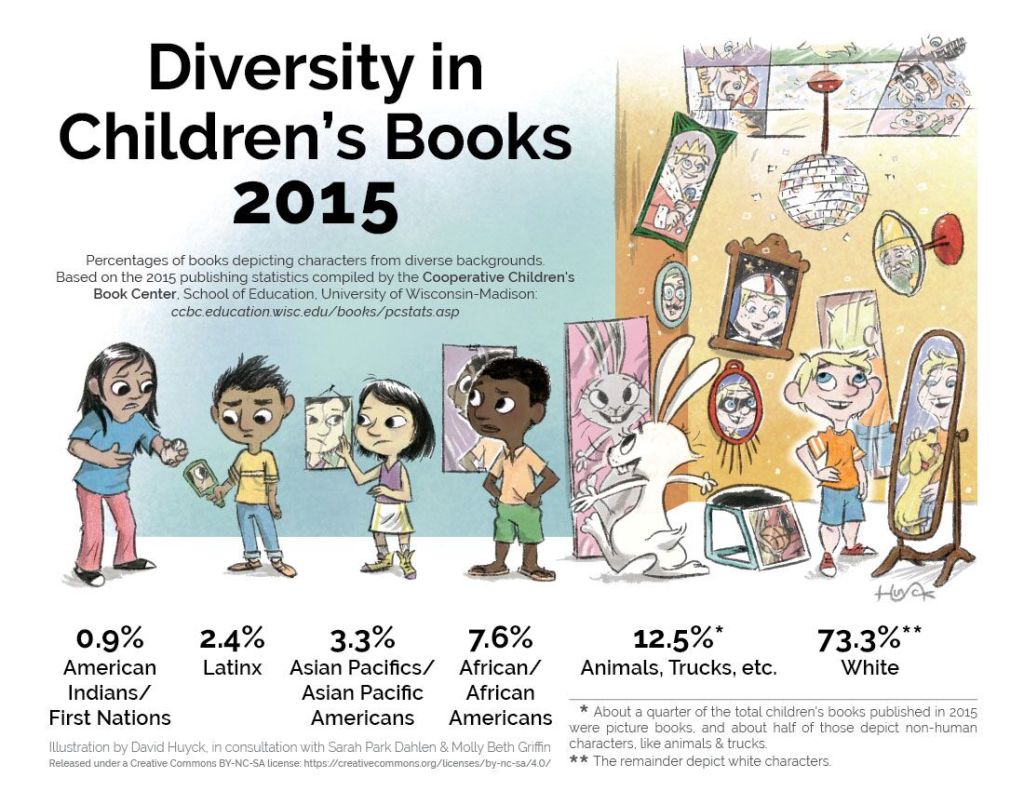
I have always thought of myself as an inclusive teacher. I try to create an environment that is both safe and welcoming, but this semester I have been challenged to look at this aspect with a critical eye. Am I truly creating the most inclusive environment for my students? What can I do to make my classroom more inclusive? I have learned that it is better to be proactive when thinking about these questions. According to Stachowiak (2018), “Being proactive rather than reactive means that you think critically about your classroom community before you set foot into the physical space. A critical look at the posters and displays, picture books and textbooks, word choice, and rules and procedures will help you to see where you can be more inclusive in your classroom.” I’ll be honest, I believe I have done a poor job making sure my classroom library is full of books that represents different races, ethnicities, religions, and genders. Seeing this infographic included below really hit home to me. The majority of the books that my students are reading include mostly white characters. What kind of unrealistic world do they they live in if they are only reading children’s books with white characters. According to Hermann- Wilmarth and Ryan (2015), “these kinds of texts supply powerful windows and mirrors for students.” A lot of times students see themselves in the characters. Therefore, I feel challenged to create a more inclusive classroom library.
When incorporating inclusion into the classroom, another aspect to think about is gender identity. While I still do not feel as comfortable with this incorporation of text, I did feel that the book George by Alex Gino did a really good job of opening up gender identity within a children’s book. There were a lot of aspects of gender identity that students are not able to read about in many other pieces of literature. However, I definitely would be hesitant in reading this book to my third graders. I know this book is more geared for middle grade students. There are a lot of references in the book that I do not feel comfortable reading out loud. For example, George talks about the anatomy of her body a lot. In the community I live in, I feel as though there would be a lot of uproar for reading this book out loud. Please know that I mean everything I am typing with upmost respect and love for all people. I would incorporate the idea of being yourself and being true to who you are. I think it is very important for students to develop a sense of identity and purpose, and it is our job as educators to help guide them on their journey.
References
Hermann- Wilmarth, J. M., & Ryan, C. L. (2015). Doing What You Can: Considering Ways to Address LgBT Topics in Language Arts Curricula. Language Arts, 92(6), 436–443.
Huyck, David, Sarah Park Dahlen, Molly Beth Griffin. (2016). Diversity in Children’s Books 2015 infographic. sarahpark.com blog. Retrieved from https://readingspark.wordpress.com/2016/09/14/picture-this-reflecting-diversity-in-childrens-book-publishing/
Stachowiak, D. (2018). Questioning the Norm. Literacy Today, 28–30.

 Mrs. Pitman's Classroom