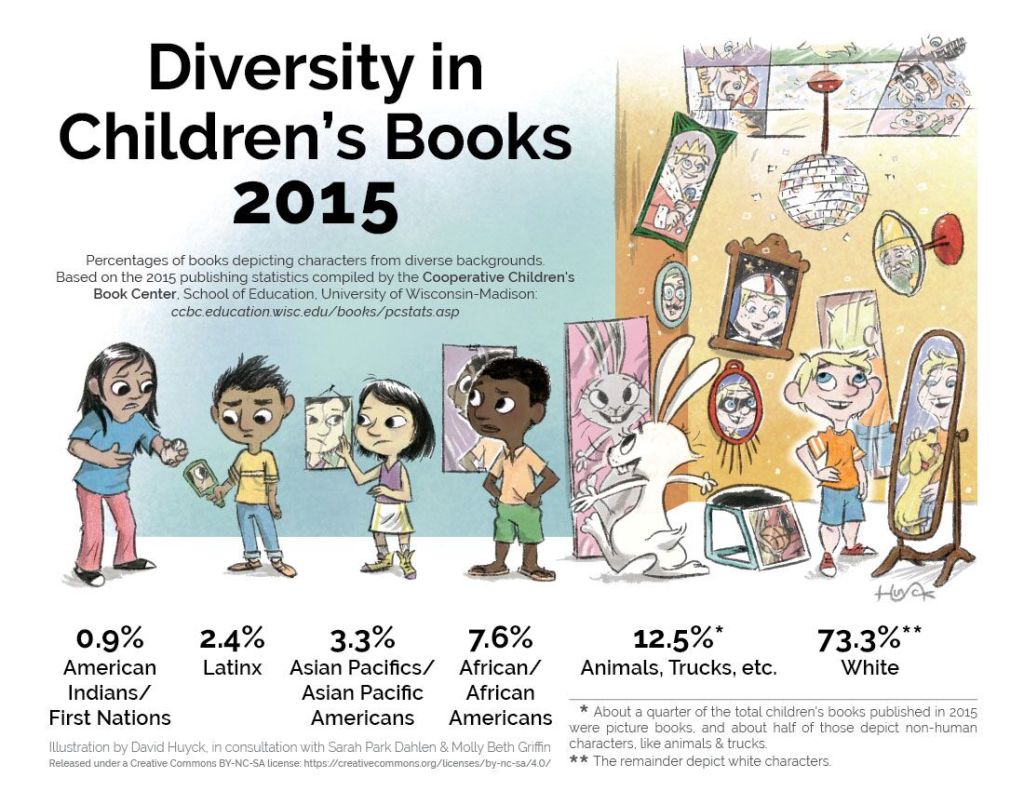
I have always thought of myself as an inclusive teacher. I try to create an environment that is both safe and welcoming, but this semester I have been challenged to look at this aspect with a critical eye. Am I truly creating the most inclusive environment for my students? What can I do to make my classroom more inclusive? I have learned that it is better to be proactive when thinking about these questions. According to Stachowiak (2018), “Being proactive rather than reactive means that you think critically about your classroom community before you set foot into the physical space. A critical look at the posters and displays, picture books and textbooks, word choice, and rules and procedures will help you to see where you can be more inclusive in your classroom.” I’ll be honest, I believe I have done a poor job making sure my classroom library is full of books that represents different races, ethnicities, religions, and genders. Seeing this infographic included below really hit home to me. The majority of the books that my students are reading include mostly white characters. What kind of unrealistic world do they they live in if they are only reading children’s books with white characters. According to Hermann- Wilmarth and Ryan (2015), “these kinds of texts supply powerful windows and mirrors for students.” A lot of times students see themselves in the characters. Therefore, I feel challenged to create a more inclusive classroom library.
When incorporating inclusion into the classroom, another aspect to think about is gender identity. While I still do not feel as comfortable with this incorporation of text, I did feel that the book George by Alex Gino did a really good job of opening up gender identity within a children’s book. There were a lot of aspects of gender identity that students are not able to read about in many other pieces of literature. However, I definitely would be hesitant in reading this book to my third graders. I know this book is more geared for middle grade students. There are a lot of references in the book that I do not feel comfortable reading out loud. For example, George talks about the anatomy of her body a lot. In the community I live in, I feel as though there would be a lot of uproar for reading this book out loud. Please know that I mean everything I am typing with upmost respect and love for all people. I would incorporate the idea of being yourself and being true to who you are. I think it is very important for students to develop a sense of identity and purpose, and it is our job as educators to help guide them on their journey.
George Book Trailer
Book Talk
References
Hermann- Wilmarth, J. M., & Ryan, C. L. (2015). Doing What You Can: Considering Ways to Address LgBT Topics in Language Arts Curricula. Language Arts, 92(6), 436–443.
“Be the change you wish to see in the world.” -Mahatma Gandhi
I’m guilty. I’m one of those teachers that sometimes says “Just ignore it and it will get better.” We know that sometimes it does not get better and something has to be done. I’ve learned this week that I have to be an activist in order to teach my students how to become them. Through careful selections in books and thoughtful discussions, students can learn to find their own voice to invoke change in the world today. According to Laminack and Kelly (2019), “children see injustice more easily and more clearly than many adults do.” I believe that is because we have learned to turn a blind eye to the injustices going on around us. The sense of apathy is something that we do not want to pass on to our students, especially if we want to see change in our world.
This week, I was given the opportunity to read two books. They were Amal Unbound by Aisha Saeed and Malala, a Brave Girl from Pakistan/Iqbal, a Brave Boy from Pakistan: Two Stories of Bravery by Jeanette Winter. Both books showed a strong, thematic connection to activism.
Learn about why the author wrote the book Amal Unbound and a little more about the book through this video.
Of course, I would begin my instruction by asking students “What do you notice about the illustration on the cover of the book? What do you wonder about the book based on the cover?” Both of these questions get students thinking about what the book will be about and any connections to their own world. On the cover of Amal Unbound, I noticed that she has henna tattoos on her hands, perhaps from a wedding. There is a book on her hand and it seems as though the books impact her life in some way because of the lines coming out from it. There is some connection to the day and night, as reflected on her fingers. In addition, it looks as though she is bound by something in some way. All of those comments might be noticed by students. Of course, they would also have many wonders in our discussion as well.
As we are reading, we would discuss the things that were happening to the characters and the issues going on around them. The characters in the books listed above are ordinary people, but ones who are strong-willed and willing to take a stand. Those are the characters that we should be showcasing to our students, especially if we want them to learn how to take a stand in their own communities/world. Amal was an ordinary girl from an ordinary family. However, she had to overcome many hardships along the way. She had to help out around the house and take care of her family while her mother was in a depressed state. In addition, she was forced into indentured servitude, when she truly did not do much harm. Amal had to overcome those hardships and still take a stand for what was truly right. Students may be able to relate to going through hard times, but still overcoming. Characters like Amal are ones that students can, in a sense, relate to even though she lived in a different area of the world. In addition to discussing the characters, we will talk about injustices present in the text. For example, in the book Separate Is Never Equal: Sylvia Mendez and Her Family’s Fight for Desegregation by Duncan Tonatiuh, students can learn about segregation of Mexican Americans and their struggle to overcome. According to Laminack and Kelly (2019), supplemental material can be added to help build students’ understanding, including photographs, primary documents, video clips, passages from other books, articles, and guest speakers. These extra “texts” allow students to better understand the social issue at hand and get a deeper comprehension of it. Once students understand the text and relate it to their own lives, the can learn how to take a stand in their own community or school. One way of doing this would be to write a letter to their principal (or another leader in charge). Students can explain the issue at hand and how they want to change it. Another idea is to write a letter to the editor of a popular book. According to Laminack and Kelly (2019), students wrote a letter to the “Who Was” series editor asking for them to include a book about Sylvia Mendez, since her family overcame such a huge obstacle. Students Showing students that they have a voice and can help to invoke change is very powerful. If they know that they can take a stand as a kid, it will help them understand that they can continue to do that for the rest of their life.
Another example that Laminack and Kelly (2019) mentioned was creating a Venn diagram to compare and contrast Malala to another important female advocate. Students could read the book Malala, A Brave Girl From Pakistan/Iqbal, A Brave Boy From Pakistan and compare/contrast her to another important figure like Rosa Parks. Learning can be taken a step further and applied to their own lives. Students can use the book to compare and contrast themselves with either Malala or Iqbal. This will show students how they are the same and different from these two characters. Students can also write about the impact these two made and how they can be advocates in their own lives.
Laminack, L. and Kelly, K. (2019). Reading to make a difference: Using literature to help students speak freely, think deeply, and take action. Portsmouth, NH: Heinemann.
Saeed, A. (2018). Amal Unbound. New York, NY: Nancy Paulsen Books.
Tonatiuh, D. (2014). Separate is never equal: sylvia mendez and her familys fight for desegregation. Harry N Abrams.
Winter, J. (2015). Malala, a brave girl from Pakistan ; Iqbal, a brave boy from Pakistan. London: Simon & Schuster Childrens.
According to Marshall (2016), Critical Race Theory (CRT) is “an especially important frame for analyzing children’s texts because its “critical and cultural critiques provide literary interpretations contextualized within multifaceted and often racialized macro systems” (Brooks, 2008, p.37).” According to Purdue Writing Lab, with this approach people can “understand how victims of systematic racism are affected by cultural perceptions and how to represent themselves to counter that prejudice.”
This week I read two children’s books that, I feel, truly allowed themselves to be represented and get their story heard. They are Separate is Never Equal: Sylvia Mendez & Her Family’s Fight for Desegregation by Duncan Tonatiuh and Can I Touch Your Hair?: Poems of Race, Mistakes, and Friendship by Irene Lathem and Charles Waters. Within Marshall’s article, “Counter Storytelling Through Graphic Life Writing,” the author included many examples of of CRT in the illustrations in Separate is Never Equal: Sylvia Mendez & Her Family’s Fight for Desegregation. There were several others present in the book, that I would like to discuss. On page 18 and 19 there is a full illustration of what seems to be Caucasian people, or individuals with light skin and hair, swimming in a pool. There is a sign saying “Nod Dogs or Mexicans Allowed, Public Pool.” The investigator is looking closely at the sign, almost questioning it himself. We can determine that because he is looking closely with a smirk on his face. Outside the gate, we see three Hispanic children looking in very sadly. They have sad expressions on their faces and seem disappointed that they do not fit the expectations. One question that came to my mind, and I am sure will other readers, is why are dogs and Mexican people related together on the sign? That seems like a very degrading remark to make. I believe the illustrator is depicting racism here.
Another illustration that caught my eye was on page 21. In this illustration, I notice Sylvia’s mother taking charge doing what society would deem a man’s job. She is on the tractor, taking charge of the family’s business, being the boss of the workers, and doing the manual labor outside. This is combatting the stereotype that women should only be indoors taking care of things in the house. The illustrator is showing that women can do just as many things as men. Another example of overcoming, in regard to racism, is on page 28. Several individuals were called to the stand to testify. It seemed in every illustration that every person was able to communicate effectively and have their voices heard. This combatted the stereotype/racism present that individuals of a different race cannot speak good English. In this case, all the individuals did not have any problem communicating.
Next, I believe it is important to give you some information about the author/illustrator of this book. According to Tonatiuh (2014), the book was “inspired by conversations with Sylvia Mendez.” Tonatiuh was born in Mexico City. His website says that he is both “Mexican and American.” If I had to guess, I would assume that he has dealt with some of the racism and stereotypes before. I like how he made it clear that he was both Mexican and American because in a sense it shows his identity and how he is not what people would assume. According to Tonatiuh, his goal is to create illustrations and write books that honor the past, but bring to light relevant principles and ideas today. The main characters in his book are of Hispanic decent, but American citizens. His book shows how they overcame racial prejudices and stereotypes and had their voices heard. The setting seemed to be out west, California, as the book says outside, in a school, in public areas, and in the courthouse. I would highly recommend this book. It shows students that there are many stereotypes and racial prejudices in our world, but how to overcome those. For more information about Duncan Tonatiuh, visit his website at http://www.duncantonatiuh.com/about.html.
Can I Touch Your Hair by Irene Latham and Charles Waters
30 second book talk
According to Irene Latham and Charles Waters (2018), wrote this book to “start conversations and change lives.” Their focus is to make the world a better place. I love the story behind this book. In the Author’s Note, it says that the project began with an email between the two authors that was a conversation about race. In addition, they also discussed how experiences have shaped lives. The poems within the book are based on their real-life experiences in public schools. The authors took into account their emotions and memories. I think this important to note because the authors had insight into what they were writing about. They could relate to it, which I definitely notice in the book. It seems almost more insightful because I feel like I am stepping into someone’s life. The illustrators, Sean Qualls and Selina Alko (2018), also wanted their illustrations to “ignite conversations about race and identity.” They mixed acrylic paint, colored pencil, and collage, just like the mixing of cultures. I loved how the illustrations incorporated newspaper clippings. It seemed like some of those clippings related to the poems.
The main characters in the book develop an amazing friendship. Irene, a blue eyed, blonde hair student who is white and Charles, who is black, overcome misunderstandings of race to become close friends. By becoming partners, they learn more about each other and begin to understand one another. The setting of the story is at school, public places, and at home.
This book would be great to use in a classroom. Reading these poems would allow whole class discussions about race. We could tie it in with identity as well. As a class we could talk about perceptions of people and how those perceptions make you feel. Students could even write their own poem about their own life experiences.
References
Brooks, W. (2008). An author as a counter-storyteller: Applying critical race theory to a Coretta Scott King award book. Children’s Literature in Education, 40, 33-45.
Latham, I., & Waters, C. (2018). Can I Touch Your Hair? Poems of Race, Mistakes, and Friendship. S.l.: Oneworld Publications.
This week I had the privilege of reading the book The Parker Inheritance by Varian Johnson. I’ll be honest, this is a book that I received in my Scholastic book order last year and thought “this looks good.” I never took the opportunity to read it, but instead, it became another addition to my classroom library. After reading the book, I am now looking back and wondering what other books did I cast aside and miss out on an amazing read? Let me start peaking your interest in this amazing book with two videos, one in which the author speaks about the book and a book trailer for the book.
The Parker Inheritance book trailer
You have to be on the edge of your seat by now, ready to dive into this book. Hopefully after students see the trailer, they will be ready to dive in as well. I think the best place to get started is by looking at the cover of the book. One thing I have been taught, is to think critically about ALL aspects of a book, even its cover and the font that was used in the text. In regard to the cover, you will notice that part of the illustration is in color, while the other part is in black and white. You will also notice that it looks as though the main characters are biking toward the black and white part of the illustration. I take this as the characters are diving into the past, which they are. The Parker Inheritance does a great job of incorporating pop culture and aspects of today’s society into the story, but also relieving the past. I love how Johnson incorporates real life ideology and history into the book as well. Another important aspect to note is that the main characters are not your typical “blue eyed, white children” which dominate the children’s literature scene. It is important for students to read a wide variety of literature, ones that reflect different cultures and walks of life. I like what Boyd, Causey, and Galda (2015) had to say, “No group or individual has a single story, and knowing only one story leads to the creation of assumptions and stereotypes.” Therefore, it is important for us, as teachers, to incorporate many examples of pieces of literature to reflect different cultures. Students are not going to completely understand a culture by reading one book. Instead, we must fully immerse them in many.
Next, after reading The Parker Inheritance, I was full of questions. Was this based on a true story? Was there actually a fortune that was hidden by clues in South Carolina? I love watching Expedition Unknown. This show is hosted by archaeologist Josh Gates and sends him on so many adventures trying to solve unknown mysteries. I kept thinking, “wow, this could be the next Josh Gates adventure!” I needed to read more about the author and the book. One website I turned to was The Story Behind the Parker Inheritance, included below. http://varianjohnson.com/books/the-parker-inheritance/story-behind-parker-inheritance/ In fact, the book was based on The Westing Game by Ellen Raskin and an interaction that the author had with his brother in high school (Johnson, 2019). The puzzle and mystery aspect of the book comes from The Westing Game. In addition, Johnson tackles many social injustices and ideologies held in society, even today. Within this book, I noticed many things that did not sit well with me. Unfortunately, many of these ideologies are still prevalent today. These were ones that I found were being touched on in the book:
When Candace and Brandon were leaving the Memorial Room and the assistant principal ran into them, he thought they were up to no good based on the color of their skin. Unfortunately, this thought is still around today.
When Milo and his friends mistreated Brandon, they thought “he must be gay since he’s never had a girlfriend and was best friends with someone who wasn’t straight.”
When Brandon and his family thought Candice’s family was poor and bought her new clothes, still with tags, and offered to feed them on several occasions. While this was a nice gesture, Candice seemed to be offended.
On page 151, Johnson (2018) touched briefly on unarmed black people being hurt by the police, the very ones who are supposed to be here to protect.
Finally, the idea that people of different races should not be together romantically (pages 275-276). This is an assumption that was prevalent a long time ago, but still prevails today.
All of the ideologies that I found were very prevalent in the book, but are still around today. These social injustices are unfair assumptions. These ideologies and social injustices will continue on, unless children and adults are taught otherwise. It is our job, as teachers, to educate students on the past and how to make a better future. I have learned the best way to do this is by being immersed in culturally diverse literature. Students begin to see that our world today is made up by a variety of people that we must respect and care for.
In addition, I noticed that The Parker Inheritance touched on many visual and verbal sensitivities. These sensitivities included divorce, death, the naming of individuals, discrimination, “rough neighborhoods,” sexual orientation/coming out, and bullying. These are all things that students may run into. I know in my own life, there were a few things that really hit home with me, divorce and death. There was real authenticity to what Johnson was writing about. I believe that Johnson did a really good job of portraying the life of a child of divorce. He talked about the feelings Candice had and the struggles of living a life separate from her dad. These were all feelings that I could relate to. I know many students that read the book may be dealing with similar situation. Therefore, I believe it is important for students and teachers to be informed about divorce. There is definitely a psychological toll that divorce puts on kids. Below the illustration is a website that I found to be very helpful, even as a child of divorce myself. I believe that Johnson included tips that reduced the psychological toll of divorce on Candice, in an application style, in his book as well. I have included many that he talked about below.
Furthermore, another aspect that was brought up was death. Johnson included real emotions and struggles of losing someone close. I could almost feel Candice’s pain of losing her grandmother, especially since I lost mine within the last year. It truly made me feel like I was right back in the same situation. In addition, bullying and adults taking action was also brought into the light. Brandon was bullied constantly by Milo and his friends. It seemed as though he was bullied for his sexual orientation, which the author never came out and said forthright. Candice was his constant in the story. She did not care who he was, what kind of books he liked, or who he loved. She even took it a step further, standing up for him to his grandfather. She embodied the characteristics of a bold, kind, take action character. Therefore, the kids were the ones who took action and stood up for what they believed in. Occasionally, we read about the adults standing up for the kids. However, the kids were the ones who were taking action, solving the puzzle, and standing up for what they believed in.
What About the History?
The Parker Inheritance touched on many pieces of history that were very authentic. To begin with, Johnson included people like Althea Gibson, a true American tennis player. The book also included the incorporation of the Civil Rights Movement, Jim Crow Laws, the Ku Klux Klan, Briggs vs. Elliott, and Brown vs. Board of Education. Readers can get a glimpse into what life was like for different races, especially African Americans during the 1950’s and 1960’s. The flash backs incorporated into this book allow one to understand this time period much better. I felt a ton of empathy and questioned how people could treat humans so badly. Unfortunately, I realized that people are still being mistreated today. In addition, there were many references to pop culture included in the book: Stephen King, James Patterson, Judy Blume, iPod touch, Stevie Wonder’s “My Cherie Amour,” The Temptations, Atlanta Braves, smartphones, Carolina Panthers, and Earth, Wind, and Fire’s “September.”
Overall, I believe this book has so many positive aspects. It is one of those books that has been written in a way that allows the reader to look through a “window” to see what life was like during the Civil Rights Movement. Many readers can also look at this book as a mirror. They may see a lot of themselves reflected through Candice or Brandon. Therefore, I can definitely see this text being used in my own classroom. I believe it could touch on so many subjects. It could be used for instruction and accounts in the treatment of different people, bullying, overcoming obstacles, and so much more. If you have not read The Parker Inheritance, it definitely needs to be your next read. I can guarantee you will not regret it.
Boyd, F. B., Causey, L. L., & Galda, L. (2015). Culturally Diverse Literature Enriching Variety in an Era of Common Core State Standards. The Reading Teacher, 68(5), 378–387. doi: 10.1002/trtr.1326
Johnson, V. (2018). The Parker Inheritance. New York, NY: Arthur A. Levine Books.
This week, I was challenged to write a persona poem, focusing on a character of my choice from the book A Crack in the Sea by H.M. Bouwman. For the purpose of my poem, I focused on Kinchen, a major character in the book. Kinchen is the sister of Pip, and a protective one at that. I have included my poem below. The process was fairly easy, mainly because there was a template with sentence stems to go by. While reading the book, I made sure to take lots of notes. That definitely helped when writing my poem. At this point, I do not think my poem is done. As a writer, I can always go back and look at my poem with fresh eyes and change some words. I hope you enjoy my persona poem!
Kinchen By: Kayla Pitman
I am determined and caring I live in the lushness of Tathenn island I wonder what the Raft King wants with my beloved Pip I hear him trying to trick my brother into doing something he will regret I see Pip with his head underwater I want Pip to live a long, fulfilled life. I’m as helpful as scared I am determined, caring, thoughtful, and alert.
I question if the Raft King is a genuine person. I feel that he is hiding something I taste the Sheep’s Wool tea I worry that I will not take care of Pip the way our parents would have wanted. I excel at keeping a watchful eye I understand I cannot always be there for Pip I am determined, caring, protecting, and scared
I say the first thing that comes to mind I believe in always standing up for Pip I dream of a day that Pip will make a real impact in the world I try to put my worries aside I hope Ren will be okay while I am gone I was once an orphan But now I am an adopted daughter I am determined and caring
Poetry Instruction
Creating a poem and incorporating writing instruction reminded me of a graduate level course I took last semester. We learned how to truly teach students how to write and become good at it. According to Frye and Hash (2013), there are many steps that need to be followed in order to teach students how to write, including reading mentor texts, completing graphic organizers, following a template, doing a shared writing, allowing students to contribute, and publishing students’ work. I saw this first hand in my own classroom. We read poems by Valerie Worth and students’ works to help students understand the craft and structure of the poem. Specifically for persona poems, I would definitely read the book Freedom Over Me by Ashley Bryan. This book included persona poems of eleven slaves’ lives. After reading tons and tons of poems, we annotated on, noticing the structure, vivid verbs, and figurative language. With the plan of writing observational or object poetry, we then used a graphic organizer to get our ideas down. Using graphic organizers is very important because it allows students to organize their thoughts and understand exactly what they need to include in their poem. When writing my persona poem, I used a type of graphic organizer, sentence stems. I know if I would not have had the stems, I would have really struggled writing the poem. I am not the only one. I know students struggle a lot with writing, so any way to make writing easier, really helps students. Furthermore, we used students’ ideas to write a classroom poem together. Students could then return to our modeled poem to get ideas on structure and words to use for their own poem. Finally, we published students’ poems. Given the limited amount of time, I typed them into Google. However, in the future, I would like to allow students to type their own. We could add them to Google Classroom, our class website (if they are willing to share), a Padlet, etc.
I have learned so much about teaching writing and poetry. I have also learned how to teach a love of poetry (including myself). In the future, I cannot wait to add this new type of poetry to my poetry toolbox, persona poems.
References
Bouwman, H. M., & Shimizu, Y. (2019). A crack in the sea. New York: Puffin Books.
Bryan, A. (2016). Freedom over me: eleven slaves, their lives and dreams brought to life. New York, NY: Atheneum Books for Young Readers.
Frye, E. M., & Hash, L. A. (2013). The Voices of Children: Re-imagining the Internment of Japanese Americans through Poetry. Social Studies and the Young Learner, 25(4), 30–32.
First off, I have to admit, I have never read a book quite like A Crack in the Sea by H.M. Bouwman. This book is different than anything else I have ever read. There are so many layers to this book, that have to be peeled back one by one. Honestly, looking at the length of this book, I hoped and prayed I would like it, otherwise it was going to be a long weekend. It was, in face, an enjoyable read. Long, but enjoyable. For the purpose of today’s blog post, I want to look at this book with a critical, teacher’s eye.
A Few Things To Note:
I highly doubt that this would be a book I would read with my third graders. There are so many ideas and concepts that may be difficult for them to follow and understand. After teaching fifth grade, I feel that this would be a good book for them, especially tying it in with social studies curriculum. There are a few concepts I would want to teach before reading, including: Vietnam War, slavery, refugees, and point of views. To begin with, I would want to do a unit to explain the difference between a slave and refugee. These concepts are highly prevalent in this book. Whether it be the slave ship, transporting lots of people against their will, or Pip being taken from his home unwillingly, both of these concepts relate to slavery. Students need to understand the Middle Passage and the conditions these people were living in. In addition, students need to know about refugees. Even today, students can learn about Syrian refugees to discover how there are some today looking for a better life. I think it would be a really good idea for students to read excerpts and look at pictures of both of these concepts. One text that would be really beneficial in using to learn about refugees is Dreamers by Yuyi Morales. This book explains how a mother and child left their lives behind in pursuit of a better one (Morales, 2018). If students have a good background knowledge of the concepts, they will better understand the book.
Next, the Vietnam War makes up one-third of this book. Thanh, Sang, and Mai are all refugees trying to leave the war-torn country of Vietnam during the Vietnam War. Students need to have a good understanding of what the war was, why it started, and our (United States) role in it as well. Having a good understanding of it will helps students visualize what was going on during the book with these characters in it. Furthermore, A Crack in the Sea would be a great resource to teach different point of views. There are three, distinct chunks related to point of view. There is Kinchen, Pip, and Ceasar’s point of view, Venus and Swimmer’s point of view, and finally Thanh, Sang, and Mai’s point of view. Students could write down notes for each section and then explain how the author weaves them all together into a carefully crafted book. Overall, there are so many concepts that can be taught when reading this book. I was pleasantly surprised at how good it is, and I know you will be too.
References
Bouwman, H. M. (2017). A crack in the sea. New York, NY: G.P. Putnam’s Sons.
I feel like I am always looking for a new book to add to my classroom library. The goal is to have a library full of all different texts that reflects our ever-changing world. This week, I had the opportunity to read three amazing children’s books. They were Red A Crayon’s Story by Michael Hall, Last Stop on Market Street by Matt De La Peña, and Rescue & Jessica A Life Changing Friendship by Jessica Kensky and Patrick Downes.
Rescue & Jessica
Ever read one of those books that make you cry? I balled like a baby during this one. I think it is because of my background knowledge of having a dog and knowing how they change our lives. Rescue and Jessica, by Kensky and Downes, enriches my life in so many ways. To begin with, this is a book that most children would be able to relate with for the simple fact that Rescue is a dog. There is something about a book that one of the main characters is a dog. I loved how we not only had the point of view of Jessica, but also of Rescue and what he was going through. This book would be great to talk about point-of-view, especially since the authors incorporated two points-of-view in the text. Next, one critical literacy piece that I have been more focused on lately is illustrations. The illustrations in this text basically have a story of their own. Scott Magoon, the illustrator, tells a story through his illustrations. According to Magoon (2018), the illustrations were created digitally. On each page, we are able to glimpse the characters’ feelings. The pages that are bright let us know that they are feeling uplifted and happy. However, the darker illustrations let us glimpse into the darker days of their journey. I am especially drawn to the page with the bridge. The characters move from the darker part of the bridge (tougher days emotionally) to the brighter side of the bridge (easier/happier days). This really allows us to see the progression of the characters. Furthermore, I believe this text would be great to use the Bookmark Technique to teach critical literacy. According to DeVoogd and McLaughlin (2004), this technique helps students “monitor their comprehension and evaluate judgements about the text.” Students create four bookmarks related to something they find interesting, something they find confusing, a vocabulary word the class needs to discuss, and an illustration that helped them understand what they read. Students may find that this text was related to the Boston Marathon bombings interesting, the concept of a service dog confusing, ‘application’ as a word needing to be discussed, and the illustration of the bridge to help them understand the story. That of course was only an example. Students may have many different bookmark options to help them better understand the text.
Furthermore, there is a lot of teaching potential within this book. One theme that is present throughout the story is overcoming challenges. Students can use this them to discuss and write about a time that they had to overcome a challenge. Once students have written, they can then compare and contrast it with the challenges present in Rescue and Jessica. Furthermore, there can even be research opportunities. Students can research the authors and illustrators to better understand why they wrote the book. It is important to note that the authors had a strong connection to this book. They were running in the Boston Marathon and were injured in the bombings that took place. Students might wonder if Jessica was a child at the time of the bombings, but she was an adult. I believe she wanted the story to be more relatable to kids, so she made Jessica a child. In addition, students can also research service dogs. A great resources is www.neads.org. Students can learn about the process of becoming a service dog and how they help around the world. A great resource for teachers comes from Candlewick Press. They have created a teaching guide for this book. It is full of questions to ask students and great discussions that can be incorporated into instruction. It can be accessed at http://candlewick.com/book_files/0763696048.btg.1.pdf.
Last Stop on Market Street
Last Stop on Market Street by Matt De La Peña incorporates so many ideas into one short text. It is important to note that it was the winner of the 2016 Newberry Medal and a 2016 Caldecott Honor book. First of all, it really allows the reader to see kindness in action. CJ is a bit negative at first, but his Nana embodies positivity in every way. She sees the good in everything and is an important role model in CJ’s life. In this book, we see an appreciation of diversity, through all types of people in all stages of life. Throughout the story Nana and CJ show an appreciation and kindness to all the people who get on the bus. Whether it was the musician or the blind man, Nana was kind to all people. I really appreciated how CJ gave up his seat to the blind man and his dog. It was a little gesture that showed respect toward another human being. The author also presented differences in social classes throughout the story. At the beginning, we see a nicer neighborhood, but by the end, the setting is in a more run-down part of town. The characters never faltered, but rather, continued to be kind and helpful to all people. In addition, I loved how the illustrations matched the text and, in a sense, told the story as well. According to Robinson (2015), the art was created with acrylic paint, collage, and some digital manipulation. This would be a great book to incorporate into the classroom to showcase diversity and kindness.
After watching the video above, it is important to note that Matt de la Peña allows a diverse culture to connect with his writing. In the video, de la Peña (2013) said that he had a hard time connecting to the stories he was reading. He wanted to give readers a connection to his writing. I believe that Last Stop on Market Street embodies everything that he was trying to do in his writing, especially since the main characters were not the typical blue-eyed, white children present in most children’s books. He also speaks to a wide variety of diversity, not only color of skin, present in our world today. It shows children that we must be kind to all people, regardless of the color of their skin, their abilities, gender, and orientation.
Red A Crayon’s Story
The final book I read this week was Red A Crayon’s Story by Michael Hall. From the very beginning, one of the questions I asked was “why is the crayon called red if it is blue?” I am sure that many others reading this book will ask the same question. Little did I know, the whole story would revolve around that little question. As I was reading the story, I could not help to think of the pressure society and people around us put on each and every one of us. We are expected to behave a certain way and do certain things, just like Red. However, once the crayons realized the talents that Red had, they seemed to appreciate him and brag on his good works.
Red A Crayon’s Story by Michael Hall would be a great addition to the classroom. This book would be great to show that every person is different and appreciating those differences. We need to stop looking at what is on the outside, but rather focus on the inside of a person. There is a lot of good in people, if we will take the time to get to know them. I love how this book portrayed that simple fact in a way that students could relate to. I think it would be really cool for students to recreate a poster about themselves. On it, they could include illustrations of what everyone around them thinks and expects of them, but also what they see in themselves. I believe this would be a great task to get to know students a bit better. It would also incorporate the theme of being true to oneself. Furthermore, another theme in this book is friendship. Red was having a very hard time accepting himself until Berry became his friend. Berry showed Red something positive about himself and things turned around for Red. As a class, we can discuss what it means to be a friend and how to treat our friends. There are many other ways to incorporate Red A Crayon’s Story into the classroom. A good resource is the Teachers’ Guide created by Harper Collins. It can be accessed at: http://4edd9444c072ad07aff7-11d966b2703d5a5467932b6516b2610f.r67.cf2.rackcdn.com/teaching-guides/TG-9780062371805.pdf.
When thinking critically about the book, one important aspect to note is the illustrations. Hall (2015) noted that the art was digitally combined with crayon drawings and cut paper. I thought the author did a really good job of connecting the text to the illustrations. One could almost retell the story, based on the illustrations. According to his website, Hall is an author and a graphic designer. He has received many honors and is the author/illustrator of a New York Times bestseller, My Heart is Like a Zoo.
So many times in the media now of days we hear the importance of keeping people out of the United States. However, we fail to remember that our country is a melting pot of all different ancestral backgrounds. This week, I was reminded to be empathetic of the ones who continue to risk it all for a better life through three wonderful children’s books, My Two Blankets by Irena Kobald and Freya Blackwood, Her Right Foot by Dave Eggers and Shawn Harris, and Wishtree by Katherine Applegate.
Evaluating from a Critical Literacy Perspective
My Two Blankets and Her Right Foot are two children’s books that do a remarkable job of tugging at heart strings. They both focus on diversity and revolve around immigration. When thinking about these two books from a critical literacy perspective, the first thing I notice is the focus itself. I really enjoyed the background information on the Statue of Liberty in Her Right Foot. I knew that it welcomed immigrants into the harbor in New York City. However, I never realized the Statue of Liberty was “moving.”
In relation to the “movement” of this iconic statue, the reader is encouraged to think critically about where she is going. Eggers (2017) does a great job of presenting different locations in New York and the surrounding areas that she might be on her way to, but opens it up to the reader to ponder this question. At the end, the book wraps up by suggesting that the Statue of Liberty is meeting the new arrivals into the country. Furthermore, Harris also presents a story through the illustrations and photographs that are used. Not only do they line up with what Eggers wrote, but they tell their own story of the Statue of Liberty. I really appreciated how I was able to look at the illustrations, but also look at the photographs as well. When we visited last April, I never noticed the ideas that were presented in the book. It has given me a new appreciation for the iconic statue.
In addition, the illustrations in My Two Blankets can also be evaluated from a critical literacy perspective as well. Before reading the book, I thought the blankets would be real items used in some way by the main characters. However, now knowing the “blankets” are words that the main character knows and understands makes much more of an impact. From the illustrations, I get the feeling of how an immigrant coming from a war-torn country would feel, sad and alone. The feeling is made even deeper when they do not know the language of the country. It really sheds light on the situation and our role in it when the other child enters the scene. If not for the character helping the child learn the language, her experience may have been a lot different. As a teacher, it makes me aware to teach a culture of responsibility to help others that we may not understand and to develop empathy for other cultures and sacrifices for a better life. I can definitely relate to this in my own life because I have a student that just moved to America from Honduras. She speaks hardly any English, and after reading this story, it makes me want to help her to understand her story better.
As a Whole
First off, I absolutely love Katherine Applegate. She wrote one of my favorite children’s books, The One and Only Ivan. Once again, I am inspired by her newest addition, Wishtree. I’ll be honest, at first I had a little bit of trouble connecting to the book, but as I kept reading I fell in love. This book, in addition to My Two Blankets and Her Right Foot weave in ideas of immigration and accepting people as they are. I love how Applegate (2017) incorporates the Wishtree as a selfless character just wanting to see the good in people and the world. Applegate does an amazing job of bringing to light social issues of mistreating cultures that are not completely understood, but showing that we can be friends with all people if we give them a chance.
All three of these books would be a great addition to any classroom, especially when talking about diversity and the acceptance of all people and cultures. They all shed light to social issues present in our society and how to overcome them. I believe that these issues should be brought to light, even at a young age. If we teach how to overcome them, then perhaps our world will be a little sweeter in the future.
References
Applegate, K. (2017). Wishtree. New York, NY: Fewer and Friends.
Eggers, D. (2017). Her Right Foot. San Francisco, CA: Chronicle Books.
Kobald, I., & Blackwood, F. (2014). My Two Blankets. Melbourne: Little Hare Books.
As a classroom teacher, I am constantly exposed to text. Some of the texts are amazing, and others are a challenge to get through. When thinking about what makes a good children’s book, I would say that it needs an interesting storyline that keeps the reader engaged, rich vocabulary (appropriate to the level it was written for), and picture support related to the text. Granted, there are times when texts are lacking one or more aspects, but generally most of them have those. This week, I had the privilege of reading two very interesting texts, The Wild Robot by Peter Brown and The Girl and the Wolf by Katherena Vermette and Julie Flett. Honestly, I enjoyed The Wild Robot more, but both stories were good. I believe both texts met my criteria for a good children’s book. They both had illustrations that matched the text and were beautiful to look at. In addition, they included rich vocabulary. The Wild Robot even included terms that were science-related that could be taught in a classroom. However, in regard to engagement, I felt that The Wild Robot did a better job of keeping me engaged in what I was reading, but it possibly could have been because I was really tired when reading The Girl and the Wolf.
Furthermore, there are many ways in which these two texts connect. Both incorporate animals that communicate. In both stories, we are able to understand what the animals are saying. In one story, the wolf can communicate with the girl, while in the other the animals communicate between themselves and the robot. When humans are incorporated into the story, they cannot understand what the animals are saying. Next, both texts incorporate some sort of journey, not only external, but internal as well. Both texts result in the main character finding their way back to where they came from. In addition, they also make a journey within themselves. The robot learns that she has a deeper purpose on the island, while the girl learns her lesson not to wander off.
Next, another element of these texts is the characters having agency at some point in the text. To begin with, Roz the robot in The Wild Robot has agency and it becomes more prevalent throughout the text. At the beginning, she is just focused on what is programmed inside her robot brain. However, as time goes on, she realizes that she can use her ideas to better her situation. At first, the animals were scared of her, but as time went on she began to use her skills and abilities as a robot to help them out. Over time, they began to treat her better and were grateful to have her in their community. At one point in the book, she even saved many of the animals from freezing to death with her ingenious ideas. Next, the girl in The Girl and the Wolf also developed agency. However, she was aided in hers by the wolf. He would not simply tell her the answer, but invited her to use her critical thinking skills to solve her problems.
The Wild Robot
I cannot say enough good things about this book. I absolutely fell in love with this book. Last year it was chosen as the Little Read for our school in fourth grade. While we griped about one more thing to incorporate in instruction, I can whole-heartedly see why it was chosen. Unfortunately I moved grades and was unable to do the Little Read with my class. This weekend was the first time I read the book. There are so many good things that can be learned from this book. To begin with, there can be many class discussions on being different, incorporating others, conflict, and how to handle problems when they arise. Aside from social skills, there are many science concepts woven throughout this book, including life cycles, animals and habitats, migration, hibernation, and weather and seasons. I love how it included scientific vocabulary. It also would allow opportunities to teach English-Language Arts concepts. From this book, I could teach onomatopoeia, personification, vocabulary, comprehension, addressing the reader, and themes. So many good things! As I read the book, I kept thinking it was a gold mind for teachers and students. However, I kept thinking back to my reading of “Story as World Making” by Kathy G. Short. According to Short (2012), “the focus is not on the stories themselves. Instead literature is used to teach something else-reading skills.” As a teacher reading the article, I immediately thought to the pressure I receive to “teach the reading skills.” I hardly ever get to think about the story at hand and the simple impact it could have on many individuals just from the story alone. At this point, I still feel conflicted on this topic, as it is constantly ingrained into me to be teaching to the test. As sad as it sounds, I am sure there are many others who would agree that they feel the same way. I would love to focus more on the story in the future, as I read there are many benefits to using this approach.
References
Brown, P. (2016). The wild robot. New York: Little, Brown and Company.
If you would have asked me a few weeks ago about my thoughts on poetry, I would have just completely shut down on poetry. I have never liked it, nor did I think I could teach it to the point that my students understand. However, after teaching poetry for the last month and reading about different strategies, I would say I am falling in love with it.
In my fifth grade ELA classroom, we have been focusing on figurative language, structures of poetry, types of poetry, and being present in the moment with poetry. Figurative language is something I work on throughout the year. We usually work on it with prose, instead of poetry, but lately have been finding it in the many pieces of poetry we have been reading. Students are able to point out an idiom hiding within the many lines we read. The precious thing is that students still laugh at some of the idioms we read. There is joy in my classroom, even with the little things. Students fell in love with the acrostic poems they created, with topics ranging from shopping to Fortnite. Fortnite became a little difficult, however, when students wanted to include writing that maybe was not school appropriate. Not that the language they were using was inappropriate, but that some of the themes on the game might not need to be talked about in great detail. One of my favorite lessons to teach, which I was observed on, is teaching poetry with song lyrics. In a two week time span, we worked on analyzing and enjoying Taylor Swift’s ‘Never Grow Up’ and Mariah Carey’s ‘Hero’ in a small group setting. My students found it hard to believe that the songs they listen to every day can be considered poetry. We were able to dive into their thoughts and feelings and what they thought the author meant by the lines they wrote. Even today, they still ask me to play those songs, singing along and putting emotion into what they are singing. The best part about our experiences with poetry in our class is that now I am seeing my students borrowing poetry books from the library. I have already seen three students clutching a Shel Silverstein book in their arms. My thoughts and ideas on poetry are dramatically changing, and I cannot wait to dive into poetry more.
Ideas for Poetry Instruction
This past week I read a lot in Awakening the Heart by Georgia Heard. According to Heard (1999), two types of poetry boxes can be used to help craft poetry, music and meaning. The meaning toolbox includes visual tools to help bring us closer to the experience of the poem. The music toolbox helps the reader experience the poem through sound and rhythm. One idea she used was ordinary to poetry. Students write down a list of simple words, such as green, tall, and old. Then they change those words into ones with poetic sounds. They compared trees to being green as limes, tall to majestic giants, and old to historic recorders of time. These simple changes allowed students to see words in a new light.
Another idea is observational poetry. This type of poetry can be used with Valerie Worth’s poem ‘safety pin.’ Students begin by analyzing a certain every day object, such as a paper clip. They write down their thoughts on what it feels like, sounds like, smells like, an animal it looks like, etc. Writing these thoughts down becomes a type of scaffold to help them as they create their own observational poem. They are able to refer back to their observations in creating the poem, instead of having to pull all their ideas out of thin air. Of course, we would begin observational poetry by having me model how to create this type of poetry. Students would be able to see how to create it and the process. We would write down our observations and then create a poem related to a paper clip together. Then I would invite students to create their own.
Being Present in the Moment
This weekend, I was invited to be present in the moment. I sat on a park bench with the cool air whipping through the air. I noticed a beautiful Dogwood tree and decided that I would work on my observational poetry with it. I grew up with a Dogwood tree in my yard and would always love the time it bloomed. It seemed like it had an endless amount of beautiful petals. I have included my thought process and poem below. I hope you enjoy!
Thoughts about the Dogwood
Dogwood Observational Poetry
References
Heard, G. (1999). Awakening the heart: Exploring poetry in elementary and middle school. Portsmouth, NH: Heinemann.
This will be my professional blog for for some of my Reading Education courses and beyond. Looking at children's literature as both a reader and writer (and a future teacher of reading and writing) through a critical lens. Sharing works of my own as I grow as a writer. And resources for reading and writing instruction. Everyone is welcome here.



 Mrs. Pitman's Classroom