
This week has been all about finding writing topics. After all, students cannot write without good writing topics. As teachers, we must help cultivate topics that students can write about. As I mentioned before, creating a heart map is great way to get the creative juices flowing. Hand maps are also great to help students relate emotions to memories. Today, I am also going to add another topic generator to the list, neighborhood maps.
Heart Maps
Heart maps are great because there is many different ways of creating these. According to Dorfman and Cappelli (2017), they can revolve around favorite people, places, or objects. It really allows students flexibility in deciding what they love. Once students create these, they have many ideas that they can then choose from to begin writing. I have included my heart map of my favorite places below.

Hand Maps
Another way to help students figure out what to write about is by creating a hand map. Hand maps relate to students’ emotions. As we know, emotions lead to great stories, and thus a great way to find new topics. Students include an emotion on each finger (five total) and then branch out ideas from those emotions. After students create hand maps, they should have lots of ideas that they can choose from to start writing.

Neighborhood Maps
A new approach that I was introduced to this week is creating neighborhood maps. According to Dorfman and Cappelli (2017), neighborhood maps allow students to list ideas connected to the map they draw. Allowing students to draw their map and then list memories/stories connected to it helps students think of topics on a level that they can relate to. I enjoyed learning about this strategy this week, so I created my first draft of a lesson using a mentor text. I have included it below. Please note, I have used some ideas from Dorfman and Cappelli (2017) in my lesson.
Your Turn Lesson:
Finding Topics from Neighborhood Maps
Hook: Read Nana in the City by Lauren Castillo. Discuss the places that pair travel to in the city and how the boy’s point of view changes from the beginning of the story to the end. Have students think about a walk through their own neighborhood and compare it with the one from the book.
Purpose: Today I am going to help you as you begin to think about writing topics. We are going to use our drawing of a neighborhood map to come up with topics to write about.
Brainstorm: Students can meet with their writing partner on the “special thinking/writing rug” to discuss the places they visit during a typical week. Students can even limit it to the locations within and around the school. Once students have shared with their partner, they will then recall those places with their classmates. The teacher may write those places down on the board.
Model: The teacher will model how to create a neighborhood map. Since there is not much time to model, the teacher will either create a small map or have already started it prior to class. When modeling, they will point out the locations on the map and write a short idea associated with the location.
Today I am going to draw a neighborhood map of the college that I am currently attending. I will start by drawing the road that I usually park on. It is called King Street. I love King Street and have so many memories there. I think I will write that it is a great place to run. From King Street, I walk to the College of Education. It is a large building right off King Street. I remember learning so many things there and fellowshipping with other teachers. From there, I always had to go to the Student Union. On one side is the best coffee shop ever, Crossroads. I used to get the best Crème Brulee Latte there. I think I will write that down. After coffee, my final stop would be the library. I loved going to the library to read books and enjoy the large windows.
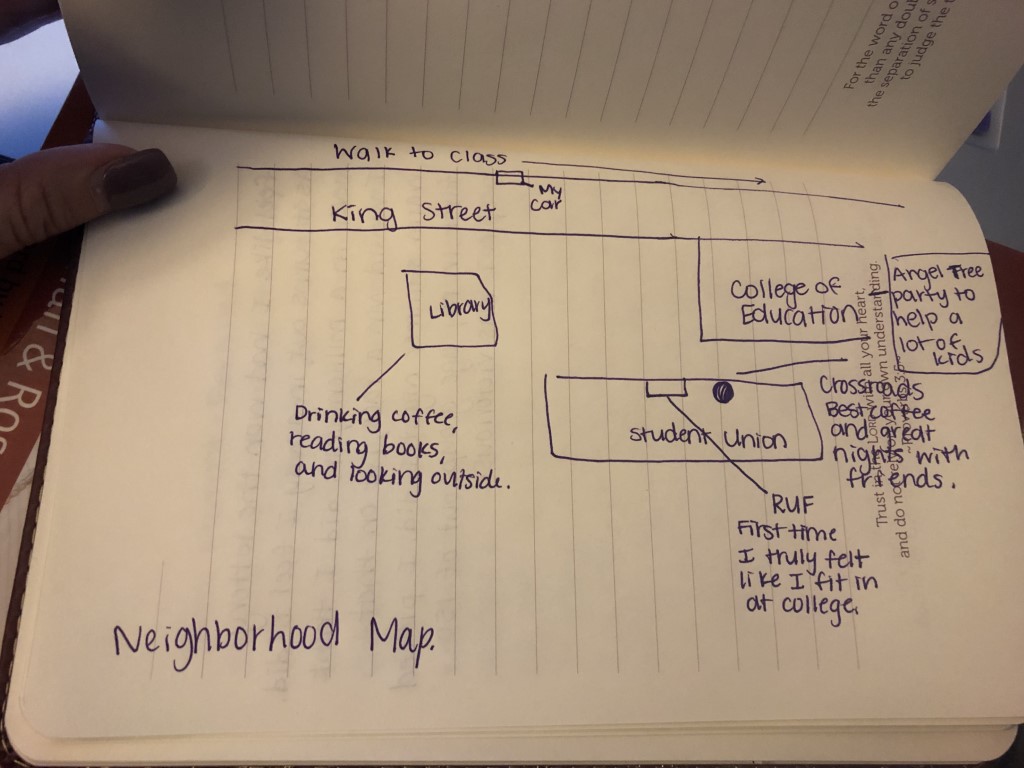
Guided Writing: To help students begin to connect to the map and better understand how to create one themselves, display a map of the school playground on the board. Ask students to help label and write down ideas of what happened in each location throughout the week. It could be an epic game of basketball or soccer or the challenging jump rope competition that went on at the blacktop. After thinking and writing down a few ideas, have students pick which one they want to write about.
Independent Practice: Allow students time to create their own neighborhood map. Their map may be of their house, neighborhood, etc. Encourage them to draw pictures, label them, and write captions related to their memories of the place. Once students’ maps have been created, allow them to turn and talk with their writing partner about one place on their map they would like to write about. Once they have had some time to discuss their ideas and stories, give students time to write.
Reflection: Once students have finished writing, have them share with their writing partner again. This time they will share the story they wrote. Encourage thought provoking questions that will allow future revisions. A few weeks after initially writing, students may return to their neighborhood map to write about another connection they have to it.
Moving Forward After Finding a Topic
Once students have decided what to write about, it is important to encourage students to continue revising their writing for it to improve over time. I am not talking about marking all over it with a red pen. It is important to model how we as writers revise by thinking about synonyms for words and including vivid vocabulary in our writing. This week, I was given the opportunity to write and revise my small moment narrative writing.


While it is very important to figure out what to write about, it is also equally important in improving writing throughout the process. As I grow as a writer, I plan to learn more ways to improve my writing as well as give my students the tools they need to do so.
References
Dorfman, L. R., & Cappelli, R. (2017). Mentor Texts: Teaching Writing
Through Children’s Literature(2nd ed.). Portland, Maine: Stenhouse.

 Mrs. Pitman's Classroom