A Week of Poetry

Honest Thoughts

Poetry. I will be honest, I cannot say that I love it. I have never really been a fan. I do not go out of my way to read it. I prefer to read novels that are written in prose. My distaste of reading poetry stems from a belief that I do not really understand what it means. I remember working on it in high school, and I really struggled to find the meaning within. I have always thought the shorter the poem and transparent it is, the better it is. As a fifth grade teacher now, I am cautious and unsure when teaching it. I guess I do not really feel like I do a good job teaching it because I was never good at analyzing it growing up. Furthermore, I definitely do not go out of my way to write it. The last poem I wrote was an acrostic poem that I was modeling for my class. Acrostic poems are fun to compose, but I do not really consider them to be true poetry in my mind. They seem to simple to be poetry. My students really enjoyed writing their acrostic poems. I think I need to do a better job of creating a poetry environment within my classroom. To do this, I need to read several poetry mentor texts. That will give students an idea of what poetry is, the different types, and the structure of poetry. It also gives them ideas for their own poetry. I also think that I need to model writing several types of poetry. When students see writing modeled, they understand the process better and feel more confident when writing their own.

Metamorphic Thinking

This week I was challenged to several readings. However, there was one that really stood out to me. Awakening the Heart by Georgia Heard includes information on how to incorporate and utilize poetry in the classroom and some ideas for activities. According to Heard (1999), a classroom environment that encourages poetry requires seven guidelines to follow.
1. Thoughts and emotions of every member of the classroom must be listened to.
2. The classroom should be a safe, inviting space in which students feel comfortable in what they are writing and sharing.
3. Poetry can be found prior to the introduction of it.
4. Students need to be reminded that there are still poets alive today, still writing new pieces for us to read.
5. Every student is a poet, no matter their ability in their writing.
6. Celebrate students’ viewpoints of the world.
7. Begin reading and writing poetry early in the year. Do not wait until the last month or so of school. Poetry takes time.

Prior to reading this book, I did not realize there were other ways to encourage an environment of poetry. I also realized that I am not the only one with negative thoughts of poetry. Heard (1999), mentioned that teaching poetry should not just be about analyzing poetry, but also helping student relate to it in their own unique way. The book, All the Small Poems and Fourteen More by Valerie Worth, includes poems about many different topics that students can read and hopefully relate to. These poems can be used within the classroom to show students that poetry does not always have to be dry and only relate to topics they have no interest in. Instead, students will be able to read about topics they can relate to in their own lives.

References

Heard, G. (1999). Awakening the heart: Exploring poetry in elementary and middle school. Portsmouth, NH: Heinemann.

Worth, V., & Babbitt, N. (2012). All the small poems and fourteen more. New York: Square Fish.

Six Word Memoirs and Crafting a Lead Sentence

This week I was challenged to create a six word memoir connected to my life. I thought it would be simple, but boy was I wrong! How do you sum up your life in six words? At first I thought I would just write down six adjectives to describe myself, but then realized that they would not really connect together. After thinking for at least fifteen minutes, I finally came up with the following six word memoir.

According to Saunders and Smith (2014), six word memoirs are relatively new, stemming from a piece by Ernest Hemingway. The goal is to sum up your life in only six words. As a fifth grade teacher, I can definitely see myself imploring this technique toward the beginning of the year. It allows students to reflect on their likes and dislikes and how they would describe themselves. This type of writing allows students to think critically. It also allows for students to connect with others who might have similar interests and passions.

Creating a Lead Sentence

After feeling satisfied with my six word memoir, I moved on to progressing students along in the writing process. Once students have found their topics and have begun writing, it is important to encourage them to strengthen their writing. One way to do this, is to help them craft a lead sentence. According to Dorfman and Cappelli (2017), crafting a lead sentence involves students using mentor text sentences and word substitutions in order to create an opening sentence in their writing. It allows students to think of stronger, more vivid words to incorporate into their writing. After reading about this strategy, I decided to create a Your Turn Lesson of my own.

Your Turn Lesson: Creating a Lead Sentence Related to Setting

This lesson is based on the lesson within Mentor Texts by Lynn Dorfman and Rose Cappelli called Crafting a Lead Sentence. The mentor text that will be used is Owl Moon by Jane Yolen. 

Hook: The first sentence of Owl Moon by Jane Yolen is a great mentor text for students to use when working on lead sentences.  This text models how to begin writing that relates to the setting.   

Purpose: Writers today we are going to work on crafting a powerful opening sentence.  To do this, we will be borrowing an author’s sentence to help us.  We will be reading one of my favorite texts, Owl Moon, to help us write an opening sentence that will help the reader visualize the setting. 

Brainstorm: The sentence from the first page of Owl Moon will be written on the paper beneath the document camera.  Four words will be underlined that students should pay careful attention to. 

It was late one winter night, long past my bedtime, when Pa and I went owling. There was no wind. The trees stood still as giant statues.   
 

As a group, students will try to think of other words that could be used to replace the word late.  The words used will be listed in the first column.  Then a new list will be created to replace the words stood still.  Finally, the last column will be created to replace the word giant. 
 
last minute               lay                    big 
slow                          pause              colossal 
behind                     prop                 enormous 
belated                   settle                gigantic 
delayed                  lounge              huge 
held up                    sit                      immense 
hung up                                            vast 
lagging 

Model: The teacher will use some of the words that were chosen to replace the underlined words in the original sentence. The sentence may be revised as the teacher sees fit. 
It was delayed one winter night, long past my bedtime, when Pa and I went owling. There was no wind. The trees paused as colossal statues. 

We were lagging one winter night, way past the time the moon made its presence, when Pa and I went owling. There was no wind.  The trees settled as vast statues. 

Shared/Guided Writing:  Students will be invited to create their own sentences, like the ones that were modeled in the group lesson.  Students will first talk with their partner about a sentence they would like to modify.  Once they have shared with their partner, they will begin writing down the sentence they would like to revise.  Once their sentence is written down, students will modify a few words, like we did in the group lesson. 

Independent Writing:  Students will be encouraged to revisit a past notebook entry that they could modify a sentence related to setting. Encourage students to find a sentence toward the beginning of their piece to revise.  If students are having a hard time finding a piece to modify, they may use the sentence they created to start a new writing piece. 

Reflection: After students have finished, have them share their new sentences with their writing partner.  Allow time for each student to share.  Then, students will have time for reflection. 
     How did we go about improving our sentences? 

     What changes did you make to your sentence related to setting? 

     What is the importance of the setting in a piece? 

     Could a reader visualize the setting in your new sentence? 

References

Dorfman, L. R., & Cappelli, R. (2017). Mentor Texts: Teaching Writing  
  Through Children’s Literature(2nd ed.). Portland, Maine: Stenhouse.

Saunders, J., & Smith, E. (2014).  Every word is on trial: Six-word memoirs in the classroom. The Reading Teacher, 67 (8), 600-605.

Yolen, J., & Schoenherr, J. (1987). Owl moon.

Finding Writing Topics

This week has been all about finding writing topics. After all, students cannot write without good writing topics. As teachers, we must help cultivate topics that students can write about. As I mentioned before, creating a heart map is great way to get the creative juices flowing. Hand maps are also great to help students relate emotions to memories. Today, I am also going to add another topic generator to the list, neighborhood maps.

Heart Maps

Heart maps are great because there is many different ways of creating these. According to Dorfman and Cappelli (2017), they can revolve around favorite people, places, or objects. It really allows students flexibility in deciding what they love. Once students create these, they have many ideas that they can then choose from to begin writing. I have included my heart map of my favorite places below.

Hand Maps

Another way to help students figure out what to write about is by creating a hand map. Hand maps relate to students’ emotions. As we know, emotions lead to great stories, and thus a great way to find new topics. Students include an emotion on each finger (five total) and then branch out ideas from those emotions. After students create hand maps, they should have lots of ideas that they can choose from to start writing.

Neighborhood Maps

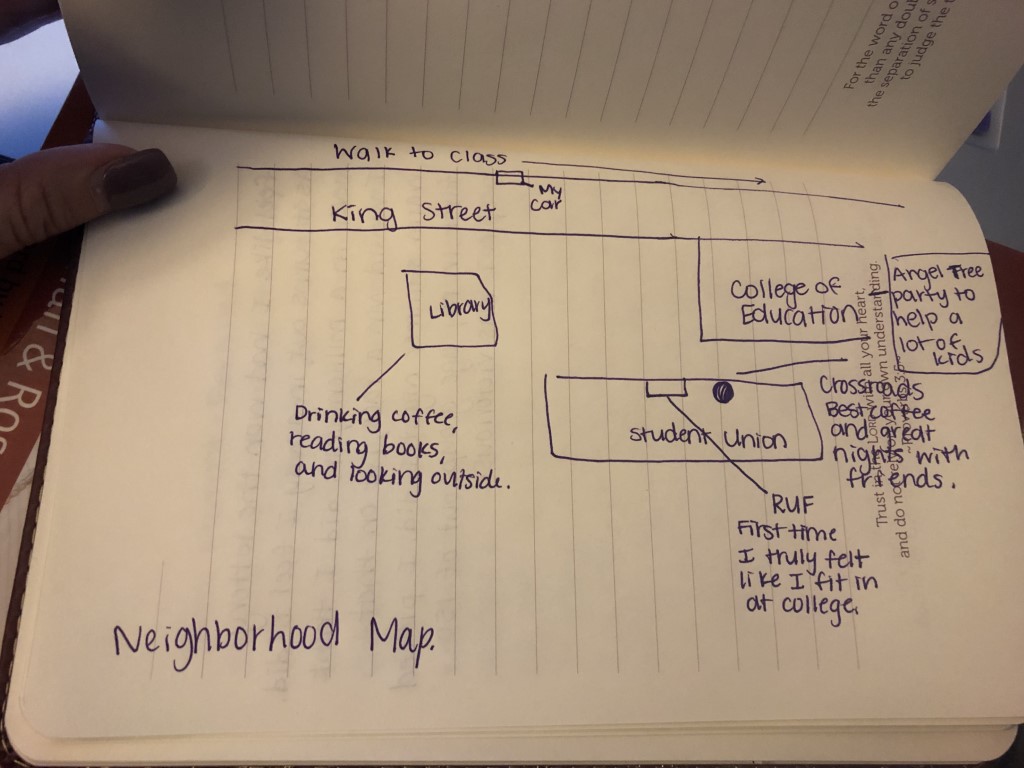
A new approach that I was introduced to this week is creating neighborhood maps. According to Dorfman and Cappelli (2017), neighborhood maps allow students to list ideas connected to the map they draw. Allowing students to draw their map and then list memories/stories connected to it helps students think of topics on a level that they can relate to. I enjoyed learning about this strategy this week, so I created my first draft of a lesson using a mentor text. I have included it below. Please note, I have used some ideas from Dorfman and Cappelli (2017) in my lesson.

Your Turn Lesson: 
Finding Topics from Neighborhood Maps 

Hook: Read Nana in the City by Lauren Castillo. Discuss the places that pair travel to in the city and how the boy’s point of view changes from the beginning of the story to the end.  Have students think about a walk through their own neighborhood and compare it with the one from the book. 

Purpose: Today I am going to help you as you begin to think about writing topics. We are going to use our drawing of a neighborhood map to come up with topics to write about. 

Brainstorm: Students can meet with their writing partner on the “special thinking/writing rug” to discuss the places they visit during a typical week. Students can even limit it to the locations within and around the school. Once students have shared with their partner, they will then recall those places with their classmates.  The teacher may write those places down on the board. 

Model: The teacher will model how to create a neighborhood map. Since there is not much time to model, the teacher will either create a small map or have already started it prior to class. When modeling, they will point out the locations on the map and write a short idea associated with the location. 
Today I am going to draw a neighborhood map of the college that I am currently attending. I will start by drawing the road that I usually park on. It is called King Street. I love King Street and have so many memories there. I think I will write that it is a great place to run.  From King Street, I walk to the College of Education. It is a large building right off King Street. I remember learning so many things there and fellowshipping with other teachers.  From there, I always had to go to the Student Union. On one side is the best coffee shop ever, Crossroads. I used to get the best Crème Brulee Latte there. I think I will write that down. After coffee, my final stop would be the library. I loved going to the library to read books and enjoy the large windows.  

Guided Writing: To help students begin to connect to the map and better understand how to create one themselves, display a map of the school playground on the board. Ask students to help label and write down ideas of what happened in each location throughout the week. It could be an epic game of basketball or soccer or the challenging jump rope competition that went on at the blacktop. After thinking and writing down a few ideas, have students pick which one they want to write about. 

Independent Practice: Allow students time to create their own neighborhood map. Their map may be of their house, neighborhood, etc. Encourage them to draw pictures, label them, and write captions related to their memories of the place. Once students’ maps have been created, allow them to turn and talk with their writing partner about one place on their map they would like to write about. Once they have had some time to discuss their ideas and stories, give students time to write.  

Reflection: Once students have finished writing, have them share with their writing partner again. This time they will share the story they wrote.  Encourage thought provoking questions that will allow future revisions. A few weeks after initially writing, students may return to their neighborhood map to write about another connection they have to it. 

Moving Forward After Finding a Topic

Once students have decided what to write about, it is important to encourage students to continue revising their writing for it to improve over time. I am not talking about marking all over it with a red pen. It is important to model how we as writers revise by thinking about synonyms for words and including vivid vocabulary in our writing. This week, I was given the opportunity to write and revise my small moment narrative writing.

My first draft
My second draft after revisions

While it is very important to figure out what to write about, it is also equally important in improving writing throughout the process. As I grow as a writer, I plan to learn more ways to improve my writing as well as give my students the tools they need to do so.

References

Dorfman, L. R., & Cappelli, R. (2017). Mentor Texts: Teaching Writing  
  Through Children’s Literature(2nd ed.). Portland, Maine: Stenhouse.

Encouraging a Classroom of Writing

I will be honest with you. I am a fifth grade ELA teacher who has yet to pass out writing notebooks and it is the middle of the year. I am ashamed to say that, but it is the truth. With three hour and a half blocks, I feel like I never have time to include writing heavily in the classroom due to the pressure of the weekly story, grammar lesson, incorporation of word study, and reading workshop. In addition, I’m always afraid I will have students who will say “Mrs. Pitman, I don’t know what to write about.” This week I have realized I need to let my fears and insecurities of writing go, and luckily I have read many texts this week with ideas of how to encourage a classroom of writing.

Choosing a Topic

There have been many ideas presented on choosing a topic for writing this week. One that I found especially interesting is using an inverted triangle. According to Dorfman and Cappelli (2017), this graphic organizer can be used to internalize the process of narrowing a topic. The top of the inverted triangle is very broad, but allows students to begin narrowing their ideas. By the time they finish completing the triangle, they have narrowed their territory into a specific topic. I know within my own classroom, students seem to struggle with trying to write about a topic that is too broad. However, using this strategy will allow them to really focus on a topic that they can write a lot about, instead of writing a lot about many different ideas.
Next, Dorfman and Cappelli (2017), discussed creating a hand map to think of ideas for writing. Students outline their hand and fill the finger spaces with emotions. From each finger, students can branch out to list memories associated with the emotion. Once the memories are listed, students should have several topics that they can write about. This strategy really intrigued me this week, so much that I wanted to create one myself (which I have shared below).

Hand Map

Accountability Partners

Another aspect that encourages a classroom of writing is allowing students the opportunity to talk about their ideas and writing. Aside from prewriting activities, allowing students to talk about memories, ideas, or topics before writing will allow them to be successful when the time comes to put them on paper. This collaboration also aids students when they feel “stuck.” They can talk through some of their bigger ideas to narrow their topic of writing. According to Calkins (2006), students should have a specific area in the classroom where they meet with their partners. The meeting area has students’ names (in pairs) with either the number one or two next to each name. The numbers are given so each child will know when it is their time to share with their partner. Students are encouraged to work it pairs to share ideas and help each other become better writers. It also allows students to work on their speaking and listening skills. Furthermore, I noticed that Dorfman and Cappelli (2017) spoke on this topic as well, saying that it allows students to get to know each other as writers. When the time comes for students to peer review, students will recognize the importance of collaboration to aid in becoming better writers.

I’ll leave you this week with a quote. According to Rosenthal (2016), “Just look at us, all of us, quietly doing our thing and trying to matter.” Wouldn’t it be great to see our students sitting quietly, genuinely excited about writing and feeling like what they have to say truly matters?

References

Calkins, L. M. (2006). A guide to the writing workshop, grades 3-5.Portsmouth, NH: Heinemann

Dorfman, L. R., & Cappelli, R. (2017). Mentor Texts: Teaching Writing  
  Through Children’s Literature(2nd ed.). Portland, Maine: Stenhouse.

Rosenthal, A. K. (2016). Textbook Amy Krouse Rosenthal: Not exactly a  
  memoir. NY,  NY: Dutton.